Saturday, July 19, 2014

Motivational and Inspiring short stories - The Elephant Rope


As a man was passing the elephants, he suddenly stopped, confused by the fact that these huge creatures were being held by only a small rope tied to their front leg. No chains, no cages. It was obvious that the elephants could, at anytime, break away from their bonds but for some reason, they did not.

He saw a trainer nearby and asked why these animals just stood there and made no attempt to get away. “Well,” trainer said, “when they are very young and much smaller we use the same size rope to tie them and, at that age, it’s enough to hold them. As they grow up, they are conditioned to believe they cannot break away. They believe the rope can still hold them, so they never try to break free.”

The man was amazed. These animals could at any time break free from their bonds but because they believed they couldn’t, they were stuck right where they were.

Like the elephants, how many of us go through life hanging onto a belief that we cannot do something, simply because we failed at it once before?

'Failure is part of learning; we should never give up the struggle in life'.


cheers....
 

Thursday, May 30, 2013

It Couldn’t Be Done


Somebody said that it couldn’t be done,
But he with a chuckle replied
That “maybe it couldn’t,” but he would be one
Who wouldn’t say so till he’d tried.
So he buckled right in with the trace of a grin
On his face. If he worried he hid it.
He started to sing as he tackled the thing
That couldn’t be done, and he did it.
Somebody scoffed: “Oh, you’ll never do that;
At least no one ever has done it”;
But he took off his coat and he took off his hat,
And the first thing we knew he’d begun it.
With a lift of his chin and a bit of a grin,
Without any doubting or quiddit,
He started to sing as he tackled the thing
That couldn’t be done, and he did it.
There are thousands to tell you it cannot be done,
There are thousands to prophesy failure;
There are thousands to point out to you, one by one,
The dangers that wait to assail you.
But just buckle in with a bit of a grin,
Just take off your coat and go to it;
Just start to sing as you tackle the thing
That “cannot be done,” and you’ll do it.

Cheers.......

Monday, May 13, 2013

Be The Best of Whatever You Are............


If you can’t be a pine on the top of the hill,
Be a scrub in the valley-but be
The best little scrub by the side of the rill;
Be a bush if you can’t be a tree.

If you can’t be a bush be a bit of the grass,
And some highway happier make;
If you can’t be a muskie then just be a bass
But the liveliest bass in the lake!

We can’t all be captains, we’ve got to be crew,
There’s something for all of us here,
There’s big work to do, and there’s lesser to do,
And the task you must do is the near.

If you can’t be a highway then just be a trail,
If you can’t be the sun be a star;
It isn’t by size that you win or you fail
Be the best of whatever you are!


Cheers..........

Friday, May 10, 2013

Start Where You Stand..............


Start where you stand and never mind the past,
The past won’t help you in beginning new,
If you have left it all behind at last
Why, that’s enough, you’re done with it, you’re through;
This is another chapter in the book,
This is another race that you have planned,
Don’t give the vanished days a backward look,
Start where you stand.

The world won’t care about your old defeats
If you can start anew and win success;
The future is your time, and time is fleet
And there is much of work and strain and stress;
Forget the buried woes and dead despairs,
Here is a brand-new trial right at hand,
The future is for him who does and dares,
Start where you stand.


Cheers...........

Wednesday, May 8, 2013

The Vow


No matter how deep the sadness or wide the pain,
I vow to live for a brighter day will come again.
No matter how many mistakes I’ve made in the past,
I vow to live and in the future avoid them, surefooted and fast.
No matter how many tragedies beyond my control take place,
I vow to live and stay my course within this race.
No matter how poor or rich I may ever be,
I vow to live and aspire to search for the dignity in simplicity.
No matter how much a lover may pierce the inner core of my heart,
I vow to live for like spring I’ll get a new start.
No matter how isolated and alone I may feel,
I vow to live and do something for someone else to heal.
No matter how hopeless my situation my appear,
I vow to live and reflect until my viewpoint is clear.
No matter what happens in this life – good or bad
I vow to live, do my best, and just for living – be glad.

By 

Cheers.........

Thursday, April 25, 2013

Great rules for easy living


If you open it, close it.
If you turn it on, turn it off.
If you unlock it, lock it up.
If you break it, admit it.
If you can’t fix it, call in someone who can.
If you borrow it, return it.
If you value it, take care of it.
If you make a mess, clean it up.
If you move it, put it back.
If it belongs to someone else and you want to use, get permission.
If you don’t know how to operate it, leave it alone.
If it’s none of your business, don’t ask questions.
If it ain’t broke, don’t fix it.
If it will brighten someone’s day, say it.
If it will tarnish someone’s reputation, keep it to yourself.


Tuesday, April 9, 2013

HAPPY UGADI............

History of Ugadi 


The word Yugadi can be explained as; "Yuga" is the word for "epoch" or "era", and "aadi" stands for "the beginning".[citation needed] Yugadi specifically refers to the start of the age we are living in now, Kali Yuga. Kali Yuga started the moment when Lord Krishna left the world. Maharshi Vedavyasa describes this event with the words "Yesmin Krishno divamvyataha, Tasmat eeva pratipannam Kaliyugam". Kali Yuga began on Feb 17/18 midnight 3102 BC.

Ugadi is the new year festival celebrated in Andhrapradesh, Karnataka and Maharashtra the states of India. Ugadi is the first day of new year. As per weather this day has special. Because the spring season starts from this day. In this season trees bloome with new leaves and fresh flowers. Mango trees are full of raw Mangoes and nightagles chants. All the world becomes new and fresh with greenery. The day of Chitra Shudda Padyami celebrated as new year by the Telugu people. Telugu people follows Lunar and Solar calendar combindly. As per this calendar the first month is Chitra Masam. In this month the first day is Padyami the crescent day. Telugu people believes that this on auspicious time to venture into new projects and decisions


The festival marks the new year day for people between Vindhyas and Kaveri river who follow the South Indian lunar calendar, pervasively adhered to in the states of Andhra Pradesh, Karnataka, Maharashtra and Goa.

This calendar reckons dates based on the Shalivahana era[citation needed] (Shalivahana Shaka), which begins its count from the supposed date of the founding of the Empire by the legendary hero Shalivahana[citation needed]. The Satavahana king Shalivahana (also identified as Gautamiputra Satakarni) is credited with the initiation of this era known as Shalivahana. The Salivahana era begins its count of years from the year corresponding to 78 AD of the Gregorian calendar. Thus, the year 2000 AD corresponds to the year 1922 of the Salivahana Era.
In the terminology used by this lunar calendar (also each year is identified as per Indian Calendar)[citation needed], Yugadi falls on "Chaitra Shudhdha Paadyami" or the first day of the bright half of the Indian month of Chaitra.[citation needed] This generally falls in the months of March or April of the Gregorian calendar. In 2011, Ugadi falls on April 4.

Lunar calendars have a sixty year cycle and starts the new year on Yugadi i.e., on "Chaitra Sudhdha Paadyami". After the completion of sixty years, the calendar starts a new with the first year.

Yugadi (start of new year) is based on Bhaskara II[citation needed] lunar calculations in 12th century. It starts on the first new moon after Sun crosses equator from south to north on Spring Equinox. For example, the time for the new moon for Bijapur where Bhaskaracharya was born can be determined from the website  However, people celebrate Yugadi on the next morning as Indian day starts from sun rise. Many Indians in America also celebrate Yugadi.


Observance of the festival:
The Kannada, Marathi, Telugu and the Konkani diaspora in Karnataka, Maharashtra, Goa, Andhra Pradesh and Kerala celebrate the festival with great fanfare; gatherings of the extended family and a sumptuous feast are "de rigueur". The day, begins with ritual showers (oil bath) followed by prayers
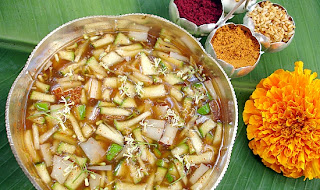


Symbolic Eating of a Dish with SixTastes:
The eating of a specific mixture of six tastes , called Ugadi Pachhadi in Telugu and Bevu-Bella in Kannada,symbolizes the fact that life is a mixture of different experiences (sadness, happiness, anger, fear, disgust, surprise) , which should be accepted together and with equanimity through the New Year.

The special mixture consists of:

    1.Neem Buds/Flowers for its bitterness, signifying Sadness
    2.Jaggery and ripe banana pieces for sweetness, signifying Happiness
    3.Green Chilli/Pepper for its hot taste, signifying Anger
    4.Salt for saltiness, signifying Fear
    5.Tamarind Juice for its sourness, signifying Disgust
    6.Unripened Mango for its tang, signifying Surprise


Special dishes:
In Karnataka a special dish called Obbattu or Holige, is prepared. In Andhra Pradesh, a special dish called Bhakshyalu or Bobbatlu (Polelu) (Puran Poli) are prepared on this occasion. It consists of a filling (Bengal gram and jaggery/sugar boiled and made in to a paste) stuffed in a flat roti like bread. It is usually eaten hot/cold with ghee or milk topping or coconut milk at some places of Karnataka.
Another dish which is prepared on occasion of Ugadi is "Pachadi". It includes 6 tastes which are Theepi,Karam,Pulupu,Vagaru,Chedu and Uppu(in telugu language). It is  prepared with the ingrediants are Neem flowers, Jaggary, chilli powder, Raw Mangoes, Salt and Tamarin ..

Recitation of Almanac ( Panchangam):
People traditionally gather to listen to the recitation of the religious Panchangam (almanac) of the new year, and the general forecast of the year to come. This is called the "Panchanga Sravanam", an informal social function where an elderly and respected person refers to the new almanac and makes a general benediction to all present. The advent of television has changed this routine, especially in the cities. Nowadays, people turn on the TV to watch broadcasts of the "Panchanga Sravanam" recitation.
Cultural and Literary events:
Ugadi celebrations are marked by literary discussions, poetry recitations and recognition of authors of literary works through awards and cultural programs. Recitals of classical Carnatic music and dance are held in the evenings.


Cheers..........